
Residential Fencing
Residential fencing for Alachua County homes.
Wood, vinyl, aluminum, and chain link fence for homeowners, installed by a company that's been building fence in Alachua County since 1983. Estimates are free, and once the scope is approved and materials are confirmed, our scheduling team will coordinate an installation date based on project requirements and current availability.
Fencing we install
We're an installer, not a materials counter — these are installation options, not a product catalog. All wood is pressure-treated pine rated for ground contact, the spec that determines whether posts hold up for five years or fifteen in Florida soil. Chain-link fabric, pipe, fittings, and hardware are commonly stocked and can often be obtained in about 2 to 3 business days; wood, vinyl, and aluminum are ordered per project — vinyl from sources including Homeland PVC, DuraFence PVC, and Poly Vinyl Creations, and aluminum from suppliers including Antebellum, Catalyst, and others. We install the material we supply — material a customer brings in isn't something we can warranty, so we don't install it. SeeFence Materials & Supplies for the full stocked-versus-orderable breakdown.
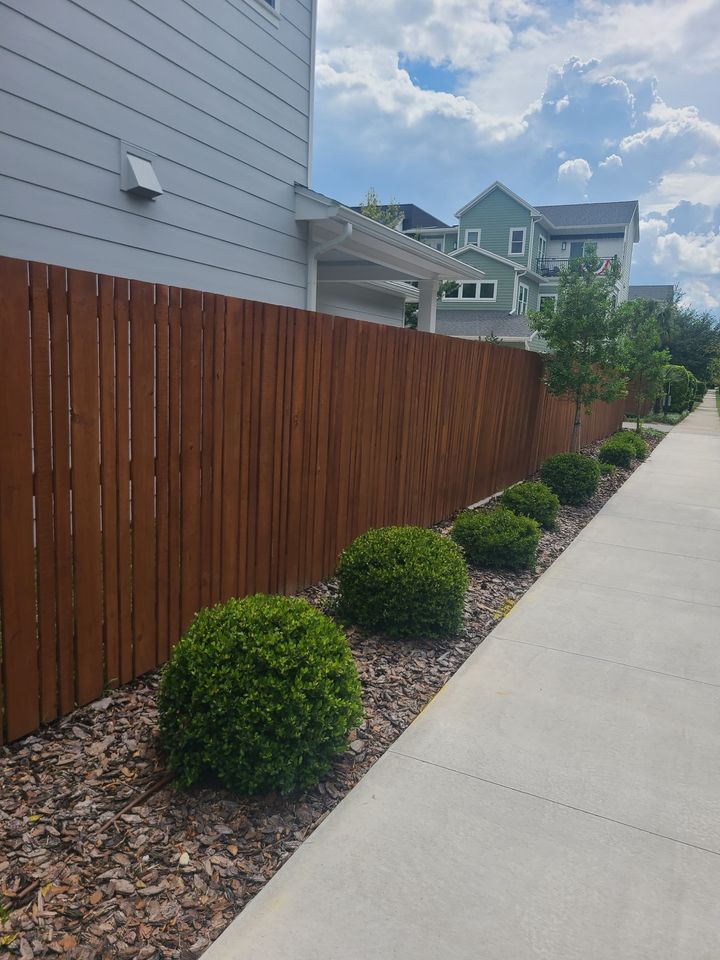
Wood Privacy
- Best for
- Full privacy — blocking sightlines from neighbors or the street.
- Typical appearance
- Solid board fence — stockade, board-on-board, or shadowbox styles, no gaps.
- Maintenance
- Higher — periodic staining or sealing recommended in Florida's humidity.
- Lead time
- Ordered per project — call to confirm current lead time.
- Available styles
- Stockade, board-on-board, shadowbox; standard height 6 ft, other heights available.
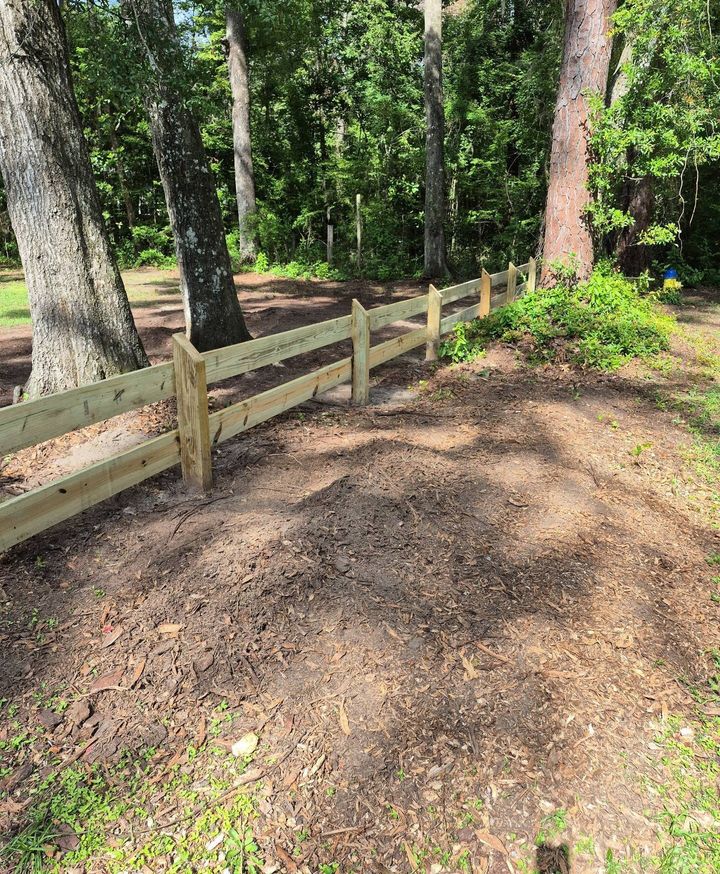
Wood Rail
- Best for
- Open sightlines — acreage, pasture, or decorative property-line marking.
- Typical appearance
- Horizontal rails between posts, no boards — fully open view through the fence.
- Maintenance
- Moderate — same pressure-treated pine, less surface area than privacy styles.
- Lead time
- Ordered per project — call to confirm current lead time.
- Available styles
- 3-rail and 4-rail.
Chain Link
- Best for
- Security and containment where an open view is fine — pets, kids, equipment yards.
- Typical appearance
- Galvanized woven-wire mesh, diamond pattern.
- Maintenance
- Low — galvanized coating resists rust.
- Lead time
- Commonly stocked — materials can often be obtained in about 2 to 3 business days.
- Available styles
- Gauge and style vary by project — ask about options when you request a quote.
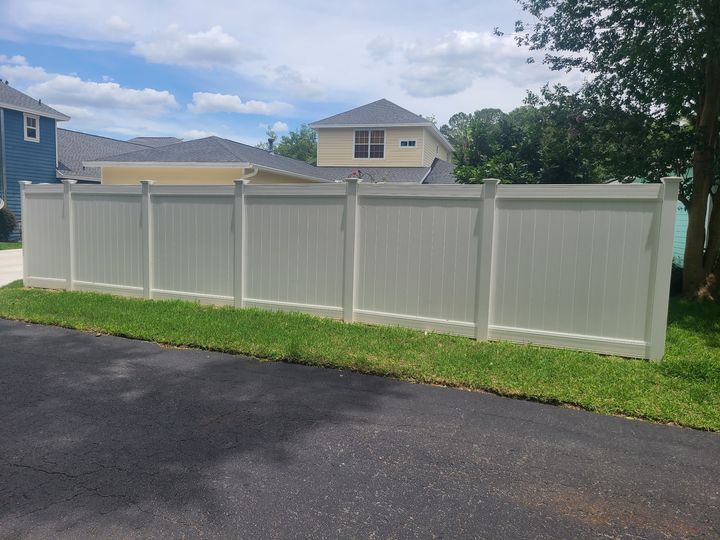
Vinyl Privacy
- Best for
- Full privacy with less upkeep than wood — no staining or sealing.
- Typical appearance
- Solid panel, uniform finish, no wood grain.
- Maintenance
- Low — occasional rinse.
- Lead time
- Ordered per job — about 1 to 1.5 weeks, on top of the install window.
- Available styles
- 6 ft standard height.
Vinyl Picket
- Best for
- Decorative front-yard fencing and pool barrier layouts that call for an open sightline.
- Typical appearance
- Evenly spaced vertical pickets, open sightline.
- Maintenance
- Low.
- Lead time
- Ordered per job — about 1 to 1.5 weeks, on top of the install window.
- Available styles
- Starts at 4 ft and goes up.
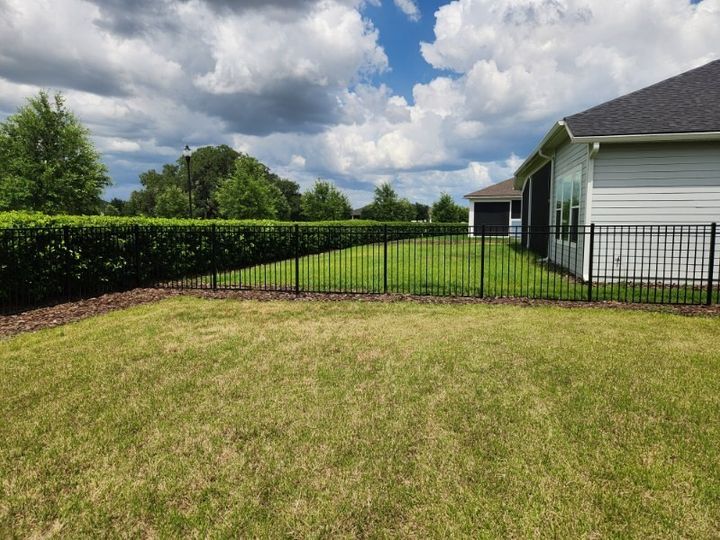
Aluminum
- Best for
- Pool enclosures and an upscale ornamental look with low upkeep.
- Typical appearance
- Slim vertical pickets, powder-coated finish.
- Maintenance
- Low — powder-coated aluminum won't rust.
- Lead time
- Ordered per job — 4 to 6 weeks, the longest lead time of our installation options.
- Available styles
- 4 ft and above.
Aluminum and vinyl picket at 4 feet and above are the styles most homeowners choose around a pool, since open sightlines pair with a compliant barrier height — more on that below.
Prefer to see and touch these materials in person? Visit ourDesign Center in Newberry.
Adding a driveway gate? SeeGates & Gate Automation for gate types, automation, and access control.
How installation works
Estimate — Free for residential jobs. We walk the property, review materials and layout, and put a proposal in writing. A deposit reserves the job and applies directly to material cost.
Property line — Establishing and marking the property boundary is the customer's responsibility, stated in our contract and in our communications up front. A survey is useful, and we ask for one to help confirm perimeter measurements, but locating the boundary markers themselves isn't something we do. We maintain relationships with local survey companies and can refer one if you don't have a recent survey.
Permit — If a permit is required, obtaining it is the customer's responsibility. In many area jurisdictions, a permit may be required for fences over 6 feet — confirm current requirements with your local building department before we finalize the design.
HOA — We provide documentation you can submit to your HOA. Interacting with the HOA and obtaining approval is the homeowner's responsibility.
811 utility locate — We file a locate request through Florida 811 before any post is driven or set in the ground, which covers public utility lines. It doesn't cover private lines on your property — irrigation, landscape lighting, invisible pet fence, private electric run to a shed or pool, or septic — so identifying those is the homeowner's responsibility.
Install — Once permitting, HOA approval, and the locate are clear, our scheduling team coordinates an installation date based on project requirements and current availability.
Walkthrough — We walk the finished fence with you before closing out the job.
Built for Florida conditions
Florida's humidity, sun, and soil wear down fencing faster than drier climates. Pressure-treated, ground-contact-rated wood is built for exactly that exposure — the alternative is a fence that looks fine for a season or two and then starts failing at the posts. Vinyl and aluminum hold up well against UV and heat with less upkeep than wood.
Wind matters as much as sun. Post depth and embedment are set to the site's soil and wind exposure, not a fixed minimum — undersized posts are the most common reason a fence fails in a storm, not the panels themselves.
Pool barrier requirements
Florida Statute Chapter 515, the Residential Swimming Pool Safety Act, sets baseline requirements for any barrier enclosing a residential pool. The barrier must be at least 4 feet high, measured on the outside, with no gaps, openings, indentations, protrusions, or structural components that would let a young child crawl under, squeeze through, or climb over it. It has to enclose the pool's perimeter — a yard fence only counts if it sits directly on the pool perimeter and meets these same requirements itself.
Gates in the barrier must open outward, away from the pool, and be self-closing and self-latching, with the release on the pool side and positioned out of a child's reach. The barrier can't be placed where a permanent structure or piece of equipment would allow climbing over it. A wall of the house counts as part of the barrier only where it has no door or window opening onto the pool area.
Above-ground pools can use the pool structure itself as the barrier, provided ladders and steps are lockable, removable, or otherwise secured when the pool isn't in use. For pools built after October 2000, at least one of five safety features has to be in place to pass final inspection: a compliant barrier, an approved safety cover, exit alarms on doors with direct pool access, self-closing and self-latching devices on those doors, or a pool alarm.
Aluminum picket and vinyl picket fencing at 4 feet and above are the styles most homeowners use to meet the barrier requirement, since open sightlines pair with a compliant barrier height. The Florida Building Code adds further dimensional specifics — gap width, picket spacing — on top of the statute, and Alachua County or the City of Gainesville may apply local amendments. This section is general orientation, not compliance advice; confirm current requirements with your local building department before finalizing a pool fence design.
Pricing
Installed price depends on fence type, height, terrain, gate count, and whether an existing fence has to come out first. Starting installed prices run from $15 per linear foot for chain link, $27 for wood privacy, and $35 for aluminum. Vinyl pricing varies by product line — call for a quote.
Financing available
Check estimated monthly payments without affecting your credit. Financing is provided through third-party lenders, not All Florida Fence Solutions — this is secondary to the free estimate, not a substitute for one.
Warranty
Ask about our workmanship warranty when you request a quote — coverage varies by material and installation type.
Frequently asked questions
Do I need a permit in Alachua County?
If a permit is required, obtaining it is the customer's responsibility, not ours. In many area jurisdictions, a permit may be required for fences over 6 feet — confirm current requirements with your local building department, since rules vary by jurisdiction.
Who confirms the property line?
You do. Establishing and marking the property boundary is the customer's responsibility, stated in our contract. We ask for a survey to help confirm perimeter measurements, but locating the boundary markers isn't something we do — we can refer a survey company if you need one.
How long does installation take?
Once the scope is approved and materials are confirmed, our scheduling team will coordinate an installation date based on project requirements and current availability — after permitting, HOA approval where it applies, and the 811 utility locate are clear. Ordered materials — vinyl (about 1 to 1.5 weeks) and aluminum (4 to 6 weeks) — add to that ahead of installation.
What about my HOA?
We provide documentation you can submit to your HOA. Interacting with the HOA and obtaining approval is the homeowner's responsibility, not ours.
How do I know where utilities are?
We call 811 for public utility locates before any post is driven or set in the ground. That covers public lines only — private lines on your property (irrigation, landscape lighting, invisible pet fence, private electric to a shed or pool, septic) are the homeowner's responsibility to identify.
Get a residential fencing quote
Tell us the material, the yard, and any HOA requirements — we'll walk the property and quote it.